Table of Contents
Timberwolf Program
Program | Badges | Meetings | Activities | Service Projects | Books | Games | Ceremonies
Structure
Timberwolves are guides who are 8 - 11 years old. They are organized into small groups of 6 - 8 which are called Sixes. All the sixes of a group together are referred to as the Pack. Generally the pack should not exceed 32 scouts.
Uniform
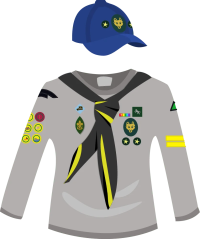 Timberwolves wear long-sleeved gray t-shirts that the badges are sewn onto and navy ball caps with the group necker.
The WFIS crest is on the right breast of the shirt and the Tenderpaw badge is on the left. A second Tenderpaw badge is sewn onto the front of the ballcap. The first and second stars are displayed on the hat on either side of the Tenderpaw badge, and can optionally be sewn on either side of the Tenderpaw badge on the shirt as well. The inclusive scouting award goes above the Tenderpad badge with the arrow pointing to the scout's heart (to the center). If earned, the swimming otter badge is displayed above the WFIS badge. The group flash is sewn onto the right shoulder with the proficiency badges sewn along the right arm below it. The right arm has the six color as well as sixer stripes.
General Program
The Timberwolf Program follows a pattern of investiture followed by earning two stars for demonstrating general scout skills. Generally they are able to earn the first star within the first 3 - 12 months. Over the next 6 - 18 months, the scout works on earning their second star, then they can focus on the twenty Special Proficiency badges available. They are also able to earn a Whittler's Card by demonstrating knife skills and safety.
Because of the need for sixes/packs to form strong bonds, it can be helpful to limit the influx of scouts into the Timberwolf Pack. Having 1 - 2 times per year that scouts may join the pack, whether that is through swimming up from the Otters or joining as a new scout, may help build pack identity. That said, if a scout is really motivated to join and catch up to the rest of the pack, you may want to make an exception. Figure out what works for your group.
Once you have invested your new scouts, it is a good idea to spend the first few months of each scouting year reviewing the first star requirements. This allows new scouts to learn those skills, and gives more experienced scouts the opportunity to review, practice, and teach them (one of the requirements for the second star is re-demonstrating the first star skills). During this time, you can also have the kids start to form their pack/six identity through team building exercises, building lairs, and having them work together on projects. You can also intermix some proficiency badge work in so that more experienced scouts can be working on new skills alongside the newer scouts.
Giving the families a rundown of what will be covered at each meeting allows kids to catch up at home if they miss an activity at a scout meeting. By covering 1 - 2 first star skills at each meeting, you should be able to get regular attendees their first star after 3 - 4 months. From there, you can start working on second star skills, knife skills, and individual proficiency badges.
Accessible and Neurodiverse Scouting
Part of our mission in OSG is to create “Scouting for Everybody.” In this quest, we not only scout with people of all races, religions, backgrounds, genders, and orientations, but also with scouts who are neurodiverse and experience a variety of physical and learning challenges.
While some of those differences make no difference to the scout leader or the program, as leaders, we may need extra skills to create an inclusive scouting program for youth who are atypical. You will find a lot of resources on Guides4Guides to help with accommodations, and on the badge page we have listed some ways you can adapt badge requirements for scouts as needed.