This is an old revision of the document!
Group Organization
Why OSG | Starting a Group | Group Organization | Registrations & Criminal History Checks | Apps & Software | Finances | Recruitment | Volunteers
At the National level, there is a board of directors that oversees the overall organization. There are also national commissioners who oversee various projects and committees. Each part of the country has a regional commissioner responsible for helping individual groups, and some areas have local/regional councils that connect them with other groups in their area. There is also a National Quartermaster who is responsible for supplying groups with scouting materials.
The individual organization of a group is as follows:
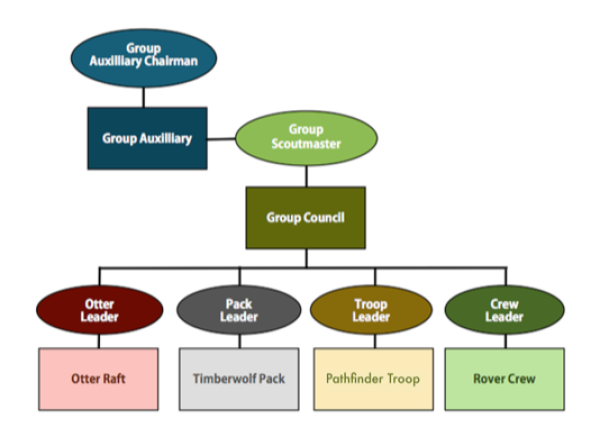
Leadership Roles
All leaders within OSG must be background checked. Those in youth leadership positions, including the Group Scoutmaster and section leaders, should be registered Rovers within the organization and plan to attend a leadership training (known as Brownsea Training Camp, or BTC) within their first year with the program. See below for more information on trainings.
Group Scoutmaster
The Group Scoutmaster (or GSM) functions as the overall leader of the scout group. They are responsible for keeping the group running and overseeing all section leaders, as well as sitting on the group auxiliary committee and being involved in the administration of the group. Being a GSM is a lot of work, but it is is also rewarding. A GSM may function as a section leader as well, depending on the availability of leadership in your group. Some groups opt to have two co-GSMs to lighten the load and take advantage of complementary skill sets, which is a good way to avoid burnout.
Group Auxiliary
The Group Auxiliary Committee is equivalent to the executive committee of a non-profit. In addition to the GSM, it comprises the following positions. These may be filled by background-checked adults or rovers and they are not required to participate in youth programming for the group.
Auxiliary Chair
This may be the GSM in a smaller group, but a larger group may have a separate Auxiliary Chair who takes on the administrative running of the group while the GSM handles the programming. Ideally the auxiliary committee will control the finances and be the signers on the bank account, which provides oversight and balances on spending by the group committee.
Group Secretary
The Group Secretary is responsible for general administration for the group. They ensure scout registrations and waivers are up to date and keeps our charter current with National. They are responsible for tracking membership numbers and knowing whether we have space for new scouts.
Group Treasurer
The Group Treasurer issues payments and reimbursements as necessary and presents a yearly financial report to the group council.
Group Quartermaster
They are responsible for tracking supply levels and reordering as necessary from the National Quartermaster. In smaller groups, this position may be combined with one of the other roles above.
Group Council
The Group Council is equivalent to the board of directors of a nonprofit (and may function as such if you pursue nonprofit status). It is generally made up of the Group Scoutmaster plus leaders from each section represented in your scout group. The Group Council is responsible for planning group activities and making decisions about spending.
For more information about leaders, see the Recruitment page.
Otter Leaders
The Otter Raft Leader(s) and Assistant Leaders oversee the Otter Raft and lead meetings.
Timberwolf Leaders
The Timberwolf Pack Leader(s) and Assistant Leaders oversee the Timberwolf Pack and lead meetings.
Pathfinder Leaders
The Pathfinder Troop Leaders and Assistant Troop Leaders (sometimes also called scoutmasters) oversee the Pathfinder Troop, lead meetings, and guide the Pathfinders in planning activities.
Rover Leaders
If your group has a dedicated Rover Crew, the Crew Leaders would also be a part of the group council.
Brownsea Training Camp
Brownsea Training Camp (or BTC) is the basic leader and adult scouting training camp, and is offered multiple times a year around the country. Currently it is in its third iteration and is being called “BTC3” as a result. If you are interested in hosting a BTC in your area, contact the National Training Commissioner for more information.
BTCs generally involve a two night camp over a weekend and cover a variety of topics useful to new leaders, including an overview of the program, review of DEI policies and youth protection practices, and instruction in various basic scouting skills necessary to obtain the rover tenderfoot badge.