This is an old revision of the document!
Otter Program
Structure
Otters are guides who are 5 - 7 years old. They are organized into small groups of 6 - 8 which are called Dens. All the dens of a group together are referred to as a Raft. Groups should not have more than 32 guides in their raft altogether (4 dens of 8 Otters each).
Uniform
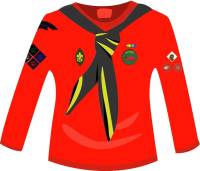 Otters wear red t-shirts (short or long sleeve) that the badges are sewn onto and red ball caps with the group necker.
The WFIS crest is on the right breast of the shirt and the Otter investiture badge is on the left. The inclusive scouting award goes above the investiture badge with the arrow pointing to the scout's heart (to the center). The group flash is sewn onto the right shoulder with the four paws arranged in a diamond pattern underneath it. The safety badge is on the left shoulder with the camping and service badges below it.
General Program
The Otter Program is broken down into 4 main “paws” plus the safety, service, and camping badges. Scouts who earn all four paws plus their safety and camping badge are able to earn the swimming otter badge to display on their Timberwolf uniform once they swim up. One thing to keep in mind is that some kids are more badge-motivated than others, and that is totally fine.
Groups may handle their rafts in different ways. Some groups have a defined scouting year where a group of Otters comes in at the start of the year and scouts together for several months. Others may have scouts joining at various points throughout the year. Having a 2 year cycle of getting through the 4 paws, with safety, camping, and service opportunities included throughout seems to be a good way of keeping things fresh while still accommodating guides who join when they are a little older.
Many groups focus on two paws per year. However many activities and meeting themes can cover several badge requirements simultaneously, and so you may end up covering some requirements from the other badges even if you are not focusing directly on them. You may also find that once your group has been scouting together for a while, you may want to plan meetings based around which badges the scouts in your group are still working on. Using a spreadsheet to keep track of the progress of all your otters can help you figure out what you want to focus on.
On the Otter Badges page, you will find a list of meetings that will accomplish all the requirements for each badge (excluding the service badge) within 24 meetings. If you meet more often, you can intersperse these with field trips for the service badge, other fun activities that aren't badge related, or just space the requirements out more. There is no wrong way to scout, and whatever works for the kids in your group is best. Here's another post from Guides4Guides about how to spread all the requirements out over three years:
Accessible and Neurodiverse Scouting
Part of our mission in OSG is to create “Scouting for Everybody.” In this quest, we not only scout with people of all races, religions, backgrounds, genders, and orientations, but also with scouts who are neurodiverse and experience a variety of physical and learning challenges.
While some of those differences make no difference to the scout leader or the program, as leaders, we may need extra skills to create an inclusive scouting program for youth who are atypical. You will find a lot of resources on Guides4Guides to help with accommodations, and on the badge page we have listed some ways you can adapt badge requirements for scouts as needed.